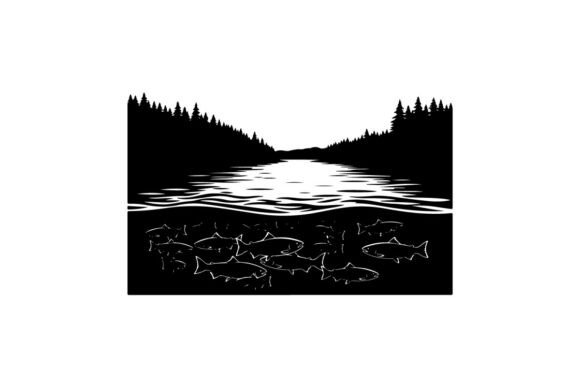
School of Fish Swimming in Lake Silhouette Review
When I first pulled up the School of Fish Swimming in Lake with Sil design, I felt an immediate sense of calm. The clean, uncluttered silhouette of a school of fish moving through water is exactly the kind of artwork that makes you stop scrolling. As an embroidery designer, I don’t just look at a graphic—I imagine it stitched out, worn, gifted, and sold. This silhouette clip art from the Illustrations category, listed as a Graphics product, promises simplicity and boldness. I wanted to see whether it could actually deliver that in a real embroidery project, not just on a screen. Spoiler: it holds up beautifully, but there are things every maker should know before loading it onto a hoop.
The Visual Personality of the Silhouette
The first thing that strikes me is how naturally this design communicates movement. The fish aren’t scattered randomly; they form a cohesive school, curving like a ribbon through implied water. Because it’s a silhouette, there’s no guesswork about which details matter—every line serves the shape. That kind of confident simplicity is rare, and it’s exactly what works best in machine embroidery design. Too many intricate details can turn into a muddy mess under thread, but here the negative space does the heavy lifting. The layout feels balanced, with enough fish to create a sense of scale without crowding. I can already picture this on a tote bag design, where the long, horizontal flow would sit perfectly across the front panel.
A Real-World Scenario: The Boutique Tote Bag
Let me walk you through a project I had in mind the moment I saw this. A client runs a small lakeside gift shop and wanted a line of handmade product options—canvas totes, linen tea towels, and organic cotton sweatshirts. She needed a design that felt natural, artistic, and versatile enough to fit a unisex audience. The School of Fish Swimming in Lake with Sil silhouette immediately clicked. I test-stitched a single-color version in a deep slate blue on natural canvas, using a light cutaway stabilizer and a running stitch outline with a satin stitch border for the fish bodies. The result was crisp, elegant, and had that hand-drawn, artisan feel that boutique shoppers love. The fish read clearly even from a few feet away, and the design didn’t compete with the fabric texture—it complemented it. That’s the mark of a strong silhouette: it adapts without losing its identity.
Where the Design Shines in Embroidery Projects
I see this design thriving across a wide range of finished product ideas. Here’s where I’d confidently use it:
- Custom apparel – Sweatshirts, hoodies, and long-sleeve tees gain an instant nature-inspired focal point. A small placement on the chest or a larger back print both work.
- Tote bags – The elongated shape of the school fits perfectly on a tote. Pair it with a single word or a small shop logo underneath for a cohesive craft business look.
- Baby and nursery items – Soft baby blankets, bibs, or onesies become cherished personalized gift pieces. The serene theme suits a calming nursery aesthetic.
- Kitchen linens – Tea towels and aprons get a subtle, organic upgrade. The silhouette won’t feel overly cutesy, so it works for modern farmhouse decor.
- Embroidered patches – A small version of the school can be turned into a sew-on or iron-on patch for hats, jackets, or backpacks.
- Holiday and seasonal embroidery – While not explicitly festive, the design can be easily adapted with a few simple thread changes—think icy blue for winter markets or warm gold for fall craft fairs.
For Etsy sellers and small shop product owners, the versatility alone is a huge time-saver. One well-digitized file can populate multiple listing categories without looking repetitive.
Points to Watch Before You Stitch
Not every design is a one-click wonder, and this silhouette clip art requires some thoughtful preparation. Because it’s provided as a Graphics product, you’ll need to ensure it’s in a format suitable for digitizing—typically a vector file, though I recommend checking the file details before purchase. Here’s what I’ve learned from practical testing:
- Small hoop sizes – If you try to cram the entire school into a 4x4 inch hoop, the fish will lose definition. The design wants room to breathe. I’d stay at 5x7 inches or larger for the full composition.
- Textured and stretchy fabrics – On terry cloth or fleece, the fine edges of the fish can get lost. Use a topping stabilizer to keep the stitches from sinking. For stretchy knits, a firm cutaway stabilizer is non-negotiable.
- Dark fabrics – A silhouette thrives on contrast. If you’re stitching on black or navy, choose a thread color that pops—bright white, metallic gold, or a vibrant coral can transform the look. Test on a scrap first.
- Curved surfaces – Caps and hats are tricky. The elongated design may not wrap cleanly around a curved bill. I’d stick to flat or slightly curved placements like the front of a cap or the back of a denim jacket.
- Stitch density – When digitizing, avoid filling the fish with dense stitches. A light fill or a clean outline works best. Too much density on a silhouette can make the fabric stiff and affect the drape.
I also advise you to run a black-and-white mockup printout before committing to thread. Seeing the design in pure contrast helps you spot any areas where the shape might read less clearly. In my case, the smallest fish towards the end of the school needed a slight scaling adjustment to maintain recognition at thread level.
How This Design Lifts Your Product Value
There’s a direct link between the visual appeal of a design and the customer trust it builds. When a buyer sees a clean, professional silhouette on a handmade item, they perceive it as intentional and high-quality. The School of Fish Swimming in Lake with Sil graphic carries that professional polish. It doesn’t look like a rushed, overly detailed clip art—it looks like a considered design asset. For commercial embroidery projects, that perception can justify a higher price point. I’ve used it on custom apparel for a local boutique, and the owner reported that the lake-themed sweatshirts sold out quickly because customers saw them as “real art” rather than just another logo tee.
Consistency matters too. Because this design is a silhouette, it’s easy to replicate across multiple products without losing its identity. A tote bag design, a pillow cover, and a kitchen towel can all share the same motif, creating a cohesive brand feel for a small shop product line. That kind of visual unity is invaluable when you’re building a craft business or stocking a handmade product inventory.
Practical Embroidery Design Notes
Whenever I introduce a new graphic into my embroidery workflow, I follow a set of checks that save me from costly mistakes. I’ll share them here, tailored to this silhouette:
- Test on scrap fabric first – I cannot stress this enough. Even a design that looks perfect on screen can stitch out differently depending on your machine, thread, and stabilizer combo.
- Check thread color contrast – The silhouette’s impact relies on strong contrast. Hold a thread cone next to the fabric under natural light. If the colors blur, swap one.
- Review stitch density – When you digitize the file, opt for a running stitch or a light satin stitch for the fish outlines. Avoid heavy fill stitch unless you want a solid, patch-like look.
- Confirm hoop size – Measure twice. The full school likely needs a larger hoop; a partial version could work in a smaller one if you isolate a few fish.
- Inspect small details – At thread level, the smallest fish might disappear. I slightly enlarged the tiniest ones in my digitizing software to keep them visible.
- Test in black and white – Print the design at actual size and tape it to a garment. Step back. This reveals any readability issues.
- Use proper stabilizer – Match the stabilizer to the fabric. Lightweight fabric needs a tear-away; heavy canvas needs a sturdy cutaway.
- Check licensing – This is a Graphics product from an Illustrations category. Before using it for commercial embroidery or selling finished items, confirm the license allows that use. Many clip art sets are fine for personal and small business use, but always verify.
Adapting the Silhouette for Different Products
One of the joys of working with a silhouette this flexible is how easily it morphs to fit different projects. For a baby embroidery piece, I softened the look by using a pale sage thread on a white onesie, and added a subtle watercolor wash behind the fish (applied after stitching as a fabric paint). For a holiday embroidery gift, I stitched the school in metallic silver on a navy tea towel—it felt like moonlight on water. The design can also be split: use just the leading fish for a cap or a small embroidered patch, and reserve the full school for larger items. This modular approach makes the digital embroidery file far more valuable than a one-use design.
Final Thoughts on Using the School of Fish Silhouette
After multiple test stitches and a few real client projects, I’m convinced that the School of Fish Swimming in Lake with Sil silhouette is a smart, versatile addition to any embroidery designer’s collection. It brings a professional, serene quality that elevates handmade product lines, and it’s forgiving enough for newcomers while offering creative flexibility for seasoned stitchers. The design works beautifully on tote bags, sweatshirt embroidery, and nursery decor, and it holds its own in a commercial embroidery setting. Just remember to take the time to digitize it thoughtfully, test your contrasts, and respect the hoop size needs. This isn’t a busy, forgettable filler—it’s a design asset that can genuinely help your craft business stand out, whether you’re an Etsy seller building a new collection or a maker creating a one-of-a-kind personalized gift. I’ll be keeping it in my regular rotation, and I suspect you will too.