Music Teacher Instructing Student Vector: Embroidery Review
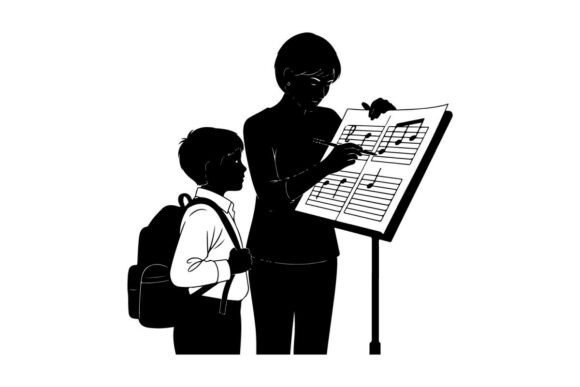
Some silhouettes carry a story before a single stitch lands on fabric. The Music Teacher Instructing Student Vector is one of those designs. I opened the file expecting a generic classroom pose, and what I found was a quiet, balanced composition that immediately felt useful. Two figures, one leaning in with an instrument, the other guiding with a gesture that reads as patient instruction. The negative space is clean, the outer edges are smooth, and the overall shape holds its own without needing embellishment. For an embroidery designer who builds products around heartfelt themes, this one lands in a sweet spot between professional and personal.
What struck me first was the restraint. So many music-themed graphics lean heavy on notes, swirls, and clutter. This Music Teacher Instructing Student Vector keeps things minimal. The silhouette approach means the relationship between the two figures does the heavy lifting. You can feel the instruction happening in the angle of the heads and the placement of the instrument. That kind of readability is exactly what you want in a design that will be stitched onto fabric, viewed from a short distance, and judged in a split second by a browsing customer.
The Mood That Sells Before You Stitch
There is a gentle authority in this design. The teacher figure stands tall without feeling stiff, and the student leans in without looking awkward. As someone who has tested hundreds of embroidery designs on actual products, I pay close attention to whether a composition breathes. This one does. The spacing between the figures is wide enough to avoid thread crowding but tight enough to read as a connected scene. That balance matters when you are planning stitch direction and choosing thread colors. A cramped design forces you into dense fill areas that can pucker on lighter fabrics. This silhouette avoids that trap entirely.
The emotional tone is gratitude, mentorship, and creativity. I can already picture this on a tote bag design for end-of-year teacher gifts, or on a simple sweatshirt embroidery for a music studio owner who wants branded apparel. The mood is warm without being sentimental, and that makes it versatile across age groups and occasions.
A Real Project Walkthrough: The Music Teacher Tote
Let me ground this in a real scenario. Last month, a client who runs a small handmade shop asked me to prepare a personalized gift line for music teachers. She wanted something that could work on canvas tote bags, zipper pouches, and unisex sweatshirts. I tested several music-themed designs, and this Music Teacher Instructing Student Vector was the one that made the final cut.
I converted the vector into a digital embroidery file and ran it on a medium-weight natural canvas tote in a soft cream color. The first test stitch used a single dark charcoal thread for the entire silhouette. The result was crisp, with clean outer edges and no awkward gaps where the instrument met the student's hands. I then tried a version with the teacher figure in a muted navy and the student in a warm taupe. The two-tone approach added depth without complicating the stitch path. Both versions looked like something a customer would pay full boutique price for.
What I appreciated most during that test was how the design scaled. I stitched it at roughly five inches wide for the tote bag, and the proportions held up. The instrument detail remained recognizable, and the faces, though stylized as silhouettes, still conveyed the teaching moment. That scalability is a direct result of the clean vector construction. When a machine embroidery design starts from a well-built source file, you spend less time cleaning up nodes and more time refining stitch angles.
Where This Design Shines Brightest
After testing on multiple products, I have a clear sense of where the Music Teacher Instructing Student Vector performs best. It belongs on items where the emotional connection matters more than decorative complexity. Think gifts, not just garments.
- Canvas tote bags – The smooth fabric takes the silhouette cleanly, and the design reads well from across a room.
- Unisex sweatshirts and crewnecks – Placed on the left chest or centered on the back, the design holds its shape on medium-weight fleece.
- Aprons for music teachers or studio owners – A subtle, professional look that feels personal without being loud.
- Pillow covers and tea towels – Excellent for home decor gifts, especially when paired with a name or short phrase underneath.
- Embroidered patches – With a simple satin stitch border, this design makes a clean, collectible patch for music students and instructors.
- Zipper pouches and pencil cases – Small enough to feel delicate, large enough to stay legible.
On all of these surfaces, the silhouette clip art nature of the design works in your favor. There is no fine internal detail that gets lost in fabric texture, no tiny lettering that blurs under thread tension. The design communicates through shape, and shape survives the embroidery process better than almost anything else.
Fabrics and Hoops: What You Need to Know
I am going to be honest about the limitations because I have learned the hard way that not every design works on every surface. The Music Teacher Instructing Student Vector is a silhouette, which means it depends on a smooth, uninterrupted outline for its impact. Fabrics with heavy texture, like thick terry cloth or chunky knit sweaters, will break up the edges and make the figures harder to read. If you are stitching on a textured surface, increase the design size slightly and use a stabilizer that prevents the fabric from shifting during the stitch-out.
Stretchy fabrics require extra care. On a thin cotton jersey t-shirt, the design can pull and distort if the stabilizer is too light. I recommend a cut-away stabilizer for any garment that will be washed frequently. The silhouette shape is forgiving in many ways, but a distorted curve on the instrument or the teacher's arm will be noticeable to anyone who looks closely.
Hoop size is another consideration. While the design scales well, I would not go below four inches wide for a detailed read. Below that, the space between the two figures begins to close up, and the stitch density in that narrow gap can become problematic. On a cap or hat, where the curved surface already challenges flat designs, I would test carefully before committing to a production run. The design works on caps, but the placement needs to be precise, and the curvature of the brim can visually compress the figures if you are not careful.
Thread Choices and Color Strategy
One of the joys of working with a silhouette is the freedom to play with thread color without worrying about interior detail matching. On a dark fabric, a single metallic or contrasting thread can turn this Music Teacher Instructing Student Vector into something striking. I tested a gold thread on a forest green apron, and the result felt elevated and gift-worthy. On light fabrics, a matte black or deep charcoal creates a classic, timeless look that appeals to a wide range of customers.
If you want to add a second color, consider splitting the figures. The teacher in one shade and the student in another creates a subtle narrative without complicating the stitch file. I would avoid introducing more than three thread colors for this design. The strength of the silhouette is its simplicity, and overcomplicating the palette weakens that.
For the Etsy Seller and Craft Business Owner
From a business perspective, the Music Teacher Instructing Student Vector fills a specific niche that many sellers overlook. Music teacher gifts are a reliable category, especially during the holiday season, end-of-year celebrations, and Teacher Appreciation Week. Yet most embroidery designs in this space lean toward cartoonish instruments or heavy text-based layouts. A clean, minimal silhouette stands out in search results and on product listing photos.
When I prepare a printable mockup or product preview for a listing, I want a design that photographs well and looks intentional. This vector does that. It presents as thoughtful and modern, which helps justify a higher price point for the finished product. Customers browsing for a personalized gift are often willing to pay more for something that feels designed rather than mass-produced. This silhouette delivers that perception.
For sellers who offer custom apparel or small shop products, the design is versatile enough to become a recurring item in your catalog. You can pair it with a teacher's name, a school name, or a short thank-you phrase stitched in a complementary font below the figures. That kind of personalization adds value without requiring a complete redesign for each order.
Practical Designer Notes Before You Stitch
I always keep a running list of checks before I take a design from screen to fabric. Here is what I recommend for this Music Teacher Instructing Student Vector:
- Test on scrap fabric first. Even a well-built vector needs a stitch-out to confirm how the fill stitch and running stitch sections behave on your specific machine and fabric combination.
- Check thread color contrast. What looks clear on a screen can blend into the fabric under real lighting. Hold the stitched sample at arm's length and in indirect light.
- Review stitch density. Silhouettes can be digitized with varying density levels. Too dense, and the fabric puckers. Too light, and the coverage looks patchy.
- Confirm hoop size. Measure the actual stitched area, not just the design file dimensions, to ensure it fits your hoop comfortably with room for the stabilizer.
- Inspect small details. Pay attention to the instrument area and the gap between the figures. These are the spots where stitching errors become visible first.
- Test in black and white mockups. A design that looks good in color should also read clearly in a single-tone version. The silhouette should hold its own.
- Compare light and dark fabric backgrounds. The same embroidery file can look dramatically different on a white canvas versus a navy sweatshirt.
- Use proper stabilizer. Do not skip this step. A silhouette design with long outer edges needs a stable foundation to prevent shifting.
- Confirm licensing before selling. Check whether the vector license covers commercial embroidery use on products you intend to sell. This is especially important for Etsy sellers and craft business owners.
A Note on Digitizing and File Preparation
Since the Music Teacher Instructing Student Vector comes from the Illustrations category as a Graphics product, it arrives as a scalable vector file rather than a ready-to-stitch embroidery format. For experienced embroidery designers, this is a feature, not a drawback. You have full control over the digitizing process, which means you can optimize stitch density, choose satin stitch or fill stitch sections, and adjust the design for your specific hoop size and machine capabilities.
If you are newer to embroidery, you will need to either digitize the design yourself or work with a digitizer who can convert the vector into a machine embroidery design file. The clean lines of this silhouette make the digitizing process straightforward. There are no complex gradients, no tiny text, and no overlapping elements that require intricate path planning. A competent digitizer can produce a clean embroidery file from this source in a short amount of time.
Who Should Use This Design
This is not a design for everyone, and that is a good thing. It suits makers who serve a thoughtful, gift-oriented customer base. If you sell handmade products at craft fairs, run a boutique embroidery shop, or build Etsy listings around teacher appreciation, music education, or personalized studio merchandise, this vector belongs in your design assets library.
It also works well for apparel decorators who want to offer a music teacher option without committing to an overly niche or seasonal design. The silhouette is specific enough to attract music educators and their families, but broad enough to avoid feeling like a one-time trend piece.
For baby embroidery and nursery decor, I can see this design adapted beautifully. Imagine it stitched on a small blanket or a soft pillow cover for a child whose parent is a music teacher. The connection is immediate and deeply personal. The same applies to holiday embroidery gifts. A music teacher receiving a custom-embroidered apron or tea towel with this design during the holiday season is going to remember that gift.
Final Thoughts From the Stitching Table
After running multiple tests, photographing results, and thinking through the customer experience, I am confident in saying the Music Teacher Instructing Student Vector earns its place in a working embroidery designer's collection. It is not flashy, and it does not try to be. What it offers is a reliable, emotionally resonant shape that stitches cleanly, scales sensibly, and appeals to a proven buyer demographic.
The simplicity of the minimal silhouette clip art approach means you spend less time troubleshooting and more time producing. For a small shop product line, that efficiency translates directly into profitability. For a personalized gift, it means a finished item that looks intentional and heartfelt. In a market crowded with overcomplicated designs, a clean silhouette that tells a recognizable story is a quiet advantage. This one tells the story of a music teacher and a student in the middle of a lesson, and that is a story plenty of people want to wear, carry, and give.